
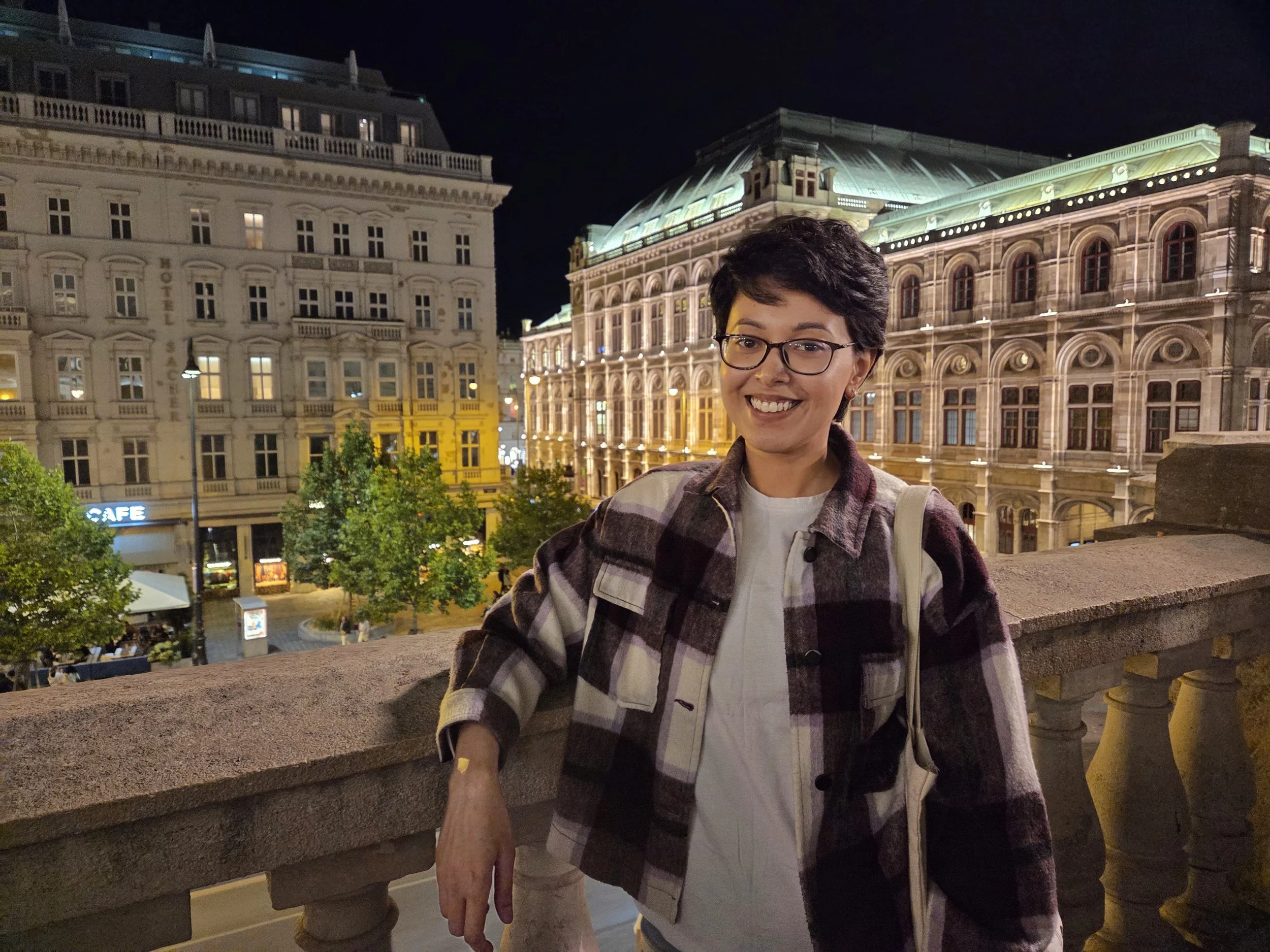
Srestha Chakraborty
PhD Candidate
Srestha Chakraborty (pronounced sray’sh–thaa) is an artist-researcher whose work explores a fascinating question: Can art change not only how we feel, but also how we think, connect, and relate to one another?
Originally from India, Srestha moved to Vienna in 2023 to join the ARTIS Lab (Art Research on Transformation of Individuals and Societies) at the University of Vienna as a PhD candidate. With an interdisciplinary academic background spanning cognitive psychology, social neuroscience, human neurophysiology, and forensic sciences, alongside an established artistic practice, they bring together disciplines that are seldom found in the same conversation.
Their doctoral research investigates the prosocial and transformative potential of visual art, particularly its capacity to influence social attitudes, foster connections across cultural boundaries, and contribute to addressing contemporary societal challenges. More specifically, their work explores how encounters with art can shape perceptions and attitudes towards migrant communities, including refugees and asylum seekers. Drawing on longitudinal experience sampling and cross-sectional behavioural methods, Srestha investigates aesthetic experiences in both museum and domestic settings, examining what happens when people engage with artworks briefly or live with them over extended periods.
A recipient of the DOC Fellowship funded by the Austrian Academy of Sciences (ÖAW), Srestha approaches their research through a decolonial, intersectional, and trauma-informed framework. Their work challenges conventional Eurocentric approaches to empirical research, advocating for more ethical, inclusive, and collaborative ways of producing knowledge.
Working closely with migrant-background artists and communities, they place particular emphasis on co-creation, representation, agency, and the power dynamics inherent in research. Their research sits within the emerging field of social neuroaesthetics, investigating how aesthetic experiences shape emotions, behaviour, and social understanding, while recognising the importance of individual histories, identities, cultures, and lived experiences. The societal ambitions of their research align with three United Nations Sustainable Development Goals: SDG 3 – Good Health and Well-being; SDG 10 – Reduced Inequalities; and SDG 16 – Peace, Justice and Strong Institutions. Ultimately, Srestha is interested in moving arts research beyond the confines of galleries and laboratories, exploring how everyday encounters with art might contribute to more empathetic, inclusive, and equitable societies.
Beyond academia, Srestha is a visual artist, calligrapher, and singer, working across mixed media, figurative and abstract illustration, calligraphy, and poetry. Their contemplative artistic practice and scientific curiosity inform one another, united by an interest in the experiences that lie beneath the surface of perception and resist easy explanation. They are also the founder of Artivist's Journal, an independent platform exploring the intersections of art, activism, and research, bringing together artists, researchers, and activists to engage in conversations around creativity, social justice, and lived experience. Describing themselves as a disabled and neuroqueer artist-researcher, Srestha is particularly interested in challenging normative assumptions about perception, aesthetics, and whose experiences count in the production of knowledge.
ORCID - www.srestha.art - LinkedIn - uCris